Evidence HubWhat Works Resources
- You are here:
-
Evidence Hub

- What Works

What Works
Yandisa Sikweyiya, Adolphina Addoley Addo-Lartey, Deda Ogum Alangea, Phyllis Dako-Gyeke, Esnat D. Chirwa, Dorcas Coker-Appiah, Richard M. K. Adanu and Rachel Jewkes
Nwabisa Shai, Geeta Devi Pradhan, Ratna Shrestha, Abhina Adhikari, Esnat Chirwa1, Alice Kerr-Wilson, Rachel Jewkes
Violence against women and girls (VAWG) is a global problem with profound consequences. Although there is a growing body of evidence on the effectiveness of VAWG prevention interventions, economic data are scarce. We carried out a cross-country study to examine the costs of VAWG prevention interventions in low- and middle-income countries. We collected primary cost data on six different pilot VAWG prevention interventions in six countries: Ghana, Kenya, Pakistan, Rwanda, South Africa and Zambia.
Sergio Torres-Rueda, Giulia Ferrari, Stacey Orangi, Regis Hitimana, Emmanuelle Daviaud, Theresa Tawiah, Rebecca Kyerewaa Dwommoh Prah, Rozina Karmaliani, Eleonah Kapapa, Edwine Barasa, Rachel Jewkes and Anna Vassall
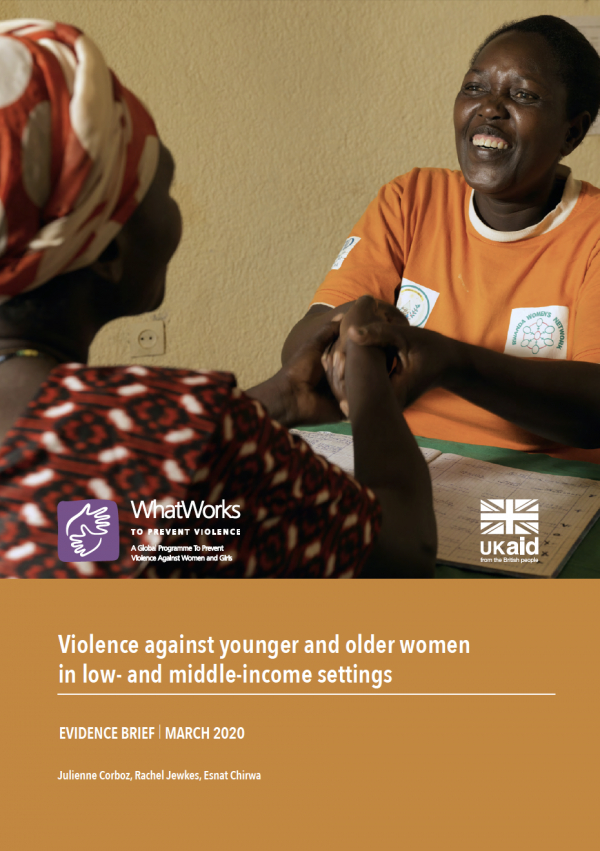
This brief synthesises knowledge gathered on the impact of age on prevalence of intimate partner violence (IPV) and the effectiveness of IPV prevention in low- and middle-income countries (LMICs) in seven interventions evaluated under the What Works to Prevent Violence Against Women and Girls Global Programme. The extent to which young women comprise a population more at risk of IPV, compared with older women, varies by geographical location and type of IPV. It is also likely that women and girls from different age groups respond to IPV prevention interventions in different ways; this may also vary according to geographical location, type of IPV, and intervention type. Nevertheless, the analysis presented in this brief suggests that young women are at greater risk of physical IPV than older women. Although younger women also appear to have experienced greater reductions in sexual and economic IPV than older women as a result of What Works interventions, there is no evidence to suggest that older women cannot, or do not, benefit from IPV prevention interventions.
Laura K. Murray, Jeremy C. KaneID, Nancy Glass, Stephanie Skavenski van Wyk Flor Melendez, Ravi Paul, Carla Kmett Danielson, Sarah M. Murray, John Mayeya, Francis Simenda, Paul Bolton
Gibbs A, Dunkle K, Mhlongo S, Chirwa, E., Hatcher, A., Christofides, C, Jewkes. Which men change in intimate partner violence prevention interventions? A trajectory analysis in Rwanda and South Africa. BMJ Global Health 2020;5:e002199. doi:10.1136/bmjgh-2019-002199
Rachel Jewkes, Andrew Gibbs, Esnat Chirwa & Kristin Dunkle (2020) What can we learn from studying control arms of randomised VAW prevention intervention evaluations: reflections on expected measurement error, meaningful change and the utility of RCTs, Global Health Action, 13:1, 1748401
Gibbs, A., Dunkle, K., & Jewkes, R. The prevalence, patterning and associations with depressive symptoms and self-rated health of emotional and economic intimate partner violence: a three-country population based study.
Sangeeta Chatterji, Erin Stern, Kristin Dunkle, Lori Heise
There is considerable interest in community organising and activism as a strategy to shift patriarchal gender norms, attitudes and beliefs and thus reduce intimate partner violence (IPV). Yet there is limited insight into how activism actually translates into reduced violence, including how aspects of programme implementation or cultural context may affect impact. This study evaluates the community activism/mobilisation portion of Indashyikirwa, a multi-component, IPV prevention programme implemented in rural Rwanda. The activism part of Indashyikirwa was based on SASA!, a promising program model from Uganda with demonstrated effectiveness.
What Works to Prevent VAWG: Research and Innovation Programme - Final Performance Evaluation
In 2013, the UK Government’s investment of £25,420,000 in the Prevention of Violence Against Women and Girls: Research and Innovation Fund (WW-VAWG), solidified HMG’s commitment to prevention of, and bringing an end to, Violence Against Women and Girls (VAWG). It set the bar for donor engagement and marked the UK as a brand-leader in the field.