Evidence HubWhat Works Resources
- You are here:
-
Evidence Hub

- What Works

What Works
Impact assessment: Rural Response System intervention to prevent violence against women and girls in four districts, Central Region of Ghana

This brief presents the evaluation findings of the Rural Response System’s community mobilisation and social norms change intervention tested under the What Works to Prevent Violence Against Women and Girls programme. It is intended to inform the work of ministries, departments and agencies (MDAs), like-minded local NGOs for women and children, leaders in the broader community, and donors working to prevent violence against women and girls (VAWG) in Ghana.
Conceptions and experiences of emotional intimate partner violence in Rwanda and South Africa
Stern, E., Gibbs, A., Willan, S., Dunkle, K., & Jewkes, R. (2019). ‘When you talk to someone in a bad way or always put her under pressure, it is actually worse than beating her’: Conceptions and experiences of emotional intimate partner violence in Rwanda and South Africa. PLOS ONE.
The study aimed at understanding factors that drive violence against women from men’s and women’s perceptive as part of a Community Randomized Control Trial aimed at reducing violence against women. It is based on the Ecological Model, a well-documented and greatly acclaimed theoretical model that considers the inclusion of multiple domains of risk and protective factors for IPV perpetration by men or IPV victimization in women and based on multiple theories that include power (unequal gender relations), resource, social learning amongst others. The model organizes factors into four levels of influence (individual, relationship, community and societal levels)[1]. Individual level factors include low education level, young age, low economic status/income, unemployment and harmful use of alcohol or illicit drugs among others, and relationship level factors include education disparity among couples or how couples communication. Acceptance of violence against women, weak community sanctions and lack of societal legislation are among those factors identified at community and societal levels. Annex 1 shows Theory of Change for the study.
The main objectives of the baseline study were to:
- To determine the past year prevalence of women’s experience of physical or sexual intimate partner violence
- To determine the past year prevalence of physical or sexual violence perpetration by men against their intimate partners in the communities
- To understand risk or protective factors associated with IPV perpetration among men or IPV experience among women.
Rethinking relationships: Moving from violence to equality
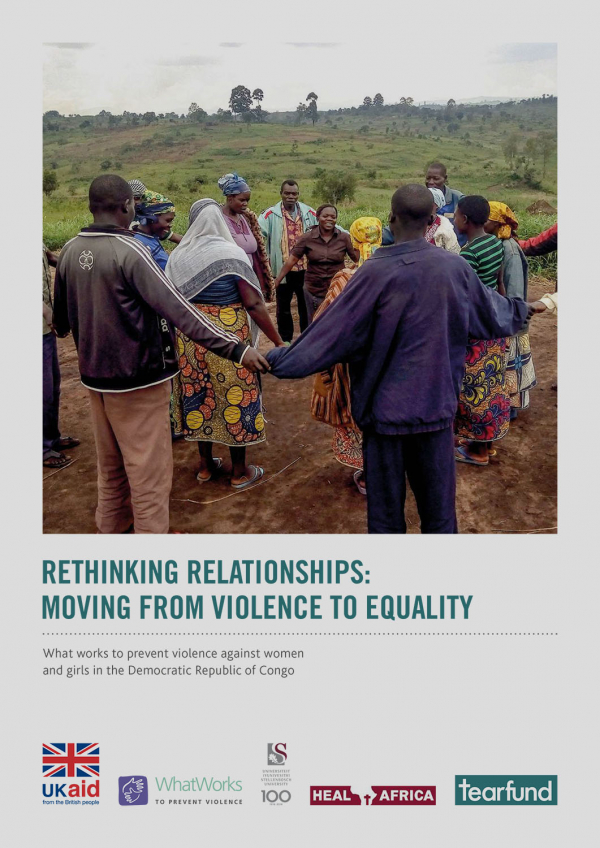
The Democratic Republic of Congo (DRC) has experienced years of conflict. Millions have died or been displaced with a collapse of basic services. While the First Congo War (1996–1997) and the Second Congo War (1998–2003) are long past, conflict-related violence continues. Violence against women and girls (VAWG) is estimated to be very high. Conflict has increased all forms of VAWG, including sexual violence perpetrated by rebels, militia, soldiers, peacekeepers and civilians, as well as intimate partner violence (IPV) in the home. Congolese society is also characterised by gender inequality with widespread impunity for perpetrators of sexual violence.1
While the media often portray sexual violence as militia-related, findings of various studies, including the present one, suggest otherwise. Promundo’s International Men and Gender Equality Survey (IMAGES) found that IPV is more prevalent than non-partner sexual violence (NPSV), with 45 per cent of women in eastern DRC reporting having ever experienced physical IPV and 49 per cent reporting having ever experienced sexual IPV. Rape as part of conflict is also high, reported by 22 per cent of women.2 The 2014 Demographic and Health Survey found that 57 per cent of ever-married 15–49-year-old women reported having ever experienced any type of IPV (physical, emotional or sexual) and 16 per cent reported experiencing sexual IPV or NPSV in the past 12 months.3 Violence against women and girls in DRC is thus not only a weapon of war but is ‘used as a weapon in daily life to oppress and abuse women and girls across the whole country’.
Javalkar, P., Platt, L., Prakash, R., Beattie, T. S., Collumbien, M., Gafos, M., ... & Bhattacharjee, P. (2019). Effectiveness of a multilevel intervention to reduce violence and increase condom use in intimate partnerships among female sex workers: cluster randomised controlled trial in Karnataka, India. BMJ Global Health, 4(6).
Gendered syndemic of intimate partner violence, alcohol misuse, and HIV risk among peri-urban, heterosexual men in South Africa
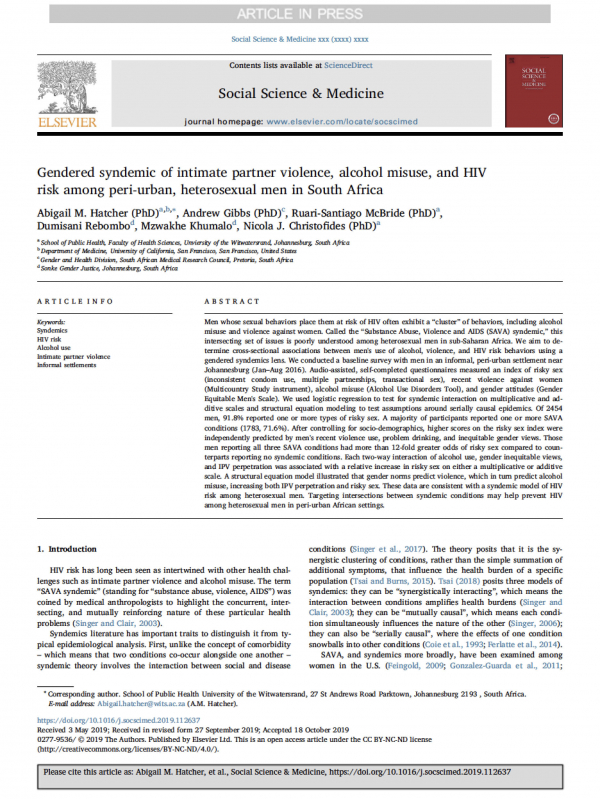
Hatcher, A. M., Gibbs, A., McBride, R., Rebombo, D., Khumalo, M., & Christofides, N. (2019). Gendered syndemic of intimate partner violence, alcohol misuse, and HIV risk among peri-urban, heterosexual men in South Africa. Social Science & Medicine, 112637.
Shifting and transforming gender-inequitable beliefs, behaviours and norms in intimate partnerships: the Indashyikirwa couples programme in Rwanda
McLean, L., Heise, L. L., & Stern, E. A. (2019). Shifting and transforming gender-inequitable beliefs, behaviours and norms in intimate partnerships: the Indashyikirwa couples programme in Rwanda. Culture, health & sexuality, 1-18.
Video - Violence is preventable - what works?
{vimeo}https://www.vimeo.com/367294545{/vimeo}
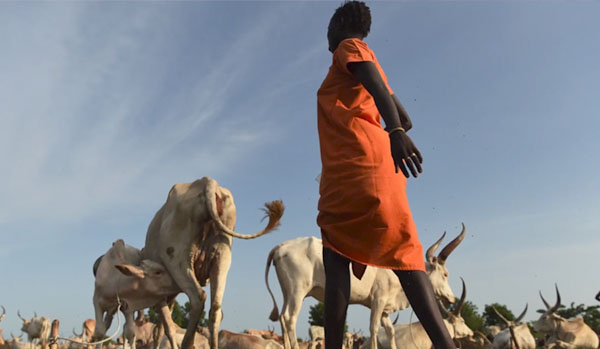
Watch our latest film capturing the results from the What Works to Prevent Violence Against Women & Girls Global Programme, funded by UK Aid, which has been investing in primary prevention efforts across Africa and Asia for the last six years, efforts that seek to understand and address the underlying causes of violence, effective interventions to prevent it and evidence on the costs of VAWG. Results from 13 countries in Africa and Asia on what works (and doesn’t) to prevent violence have shown that violence against women and girls IS preventable.
WATCH THE VIDEO BELOW...
Keep up with What Works at the 6th SVRI Forum in Cape Town
What Works joins world leaders in sexual violence prevention to advance research on violence against women (VAW) in low and middle-income countries at the 6th SVRI Forum in Cape Town, South Africa
Results from 13 countries in Africa and Asia on what works (and doesn’t) to prevent violence will be unveiled at a high-level event at the tenth Sexual Violence Research Initiative (SVRI) Forum on Wednesday 23rd October, in Cape Town, South Africa - the world’s leading research conference on violence against women, which brings together researchers, policymakers, funders and practitioners to design solutions for ending VAWG.
As rates of violence against women and girls reach epidemic proportions in South Africa global leaders in violence prevention will gather in Cape Town to address the pervasiveness of sexual assault and harassment around the world. The Sexual Violence Research Violence Initiative (SVRI)Forum, whose theme this year is “Time is Now”, will look at the impact of global movements like #MeToo, #IAmNotNext and TIME’S UP, which have been driven by a desire for equal rights and safety for all women and builds on decades of hard work of women activists and researchers.
The SVRI Forum provides a global space where delegates build knowledge, expand their networks, create collaborations and share knowledge. Over 750 delegates will attend this year’s Forum representing all key stakeholders from around the world, including UN Agencies, policymakers, government representatives, researchers, activists and funders.
The What Works to Prevent Violence Against Women & Girls (VAWG) Global Programme, funded by UK Aid, has been investing in primary prevention efforts across Africa and Asia for the last six years, efforts that seek to understand and address the underlying causes of violence, effective interventions to prevent it and evidence on the costs of VAWG.
Keep up with What Works at The SVRI Forum on twitter @WhatWorksVAWG and online at www.whatworks.co.za
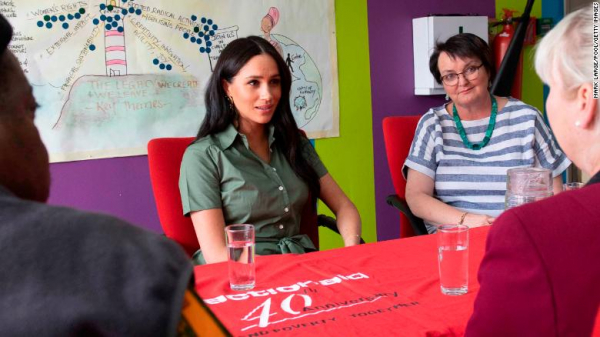
Rachel Jewkes, executive scientist for research strategy at the South African Medical Research Council, had been speaking to the Duchess about how gender-based violence needed to be tackled across all age groups at schools and mentioned new projects that encouraged building healthy relationships with the assistance of parents.