Evidence HubWhat Works Resources

Additional Info
- Country India
- Project Karnataka Health Promotion Trust - India
The influence of structural factors such as poverty, social norms, alcohol abuse, and criminalisation of high-risk behaviours on HIV risk and vulnerability has led scholars and HIV prevention programmers to regard structural intervention as an essential component of an HIV prevention strategy. Structural interventions reduce risk and vulnerability among female sex workers (FSWs) by empowering them with greater control over condom use with clients, and reducing violence and stigma against them.

Additional Info
- Country India
- Project Karnataka Health Promotion Trust - India
In response to the HIV epidemic, targeted interventions were initiated which focused on changing individual behaviour and encouraging sex workers to use condoms correctly, continuously and consistently with their clients. However it was observed in subsequent studies that though there was an increase in condom usage among sex workers during their sexual interactions with clients, the usage was less consistent when they were with their intimate partners (termed lovers in some contexts or Hiriya or Malak in the context of Karnataka).

Additional Info
- Country South Africa
- Project Stepping Stones and Creating Futures - South Africa
Stepping Stones is a workshop series designed as a tool to help promote sexual health, improve psychological well-being and prevent HIV. The workshops address questions of gender, sexuality, HIV/AIDS, gender violence, communication and relationship skills. In doing so they recognise that our sexual lives are embedded in a broader context of our relationships with our partners, families and the community or society in which we live.

Additional Info
- Country South Africa
- Project Stepping Stones and Creating Futures - South Africa
Creating Futures is a programme designed to enhance the ability of young people to think more critically in appraising opportunities and challenges related to their lives and livelihoods. It was developed for implementation among young people (18-24 years) living in urban informal settlements in South Africa. Creating Futures is designed to be facilitated by trained peer facilitators in a participatory style, encouraging participants to seek and develop relevant livelihoods for themselves through their own learning.

A Community Mobilisation Training Manual for Preventing men’s use of violence against women
Additional Info
- Country South Africa
- Project Sonke Gender Justice - South Africa
Welcome to the first booklet in the package of materials that support the Diepsloot Community Mobilisation Programme. This package offers a range of useful content for community mobilisation for the prevention of Intimate Partner Violence and, on a wider scale of Gender Based Violence.

Additional Info
- Country Zambia
- Project SHARPZ - Zambia
CETA is based on the fact that most evidence-based mental health treatments (EBTs) (most of which are cognitive behavioral) are made of similar elements or components. For example, most evidence-based treatments for a variety of disorders all contain psychoeducation, and cognitive coping. The idea is to train counselors in a range of different components that are similar across EBTs, and then teach them how to choose different orders and “dose” of components based on a client’s presenting problems.

Additional Info
- Country Bangladesh
- Project HERrespect - Bangladesh
This is a guide about how to facilitate a 90-minute session for a representative group of the HERrespect participants to come together and share and reflect on the learnings from HERrespect so far, and reaffirm the “Change Makers” concept. For this first joint session, the participants will collectively reflect on everyone’s experience of working in the factory, including both joys and challenges, in order to build a better understanding of everyone’s experiences in the factory, in order to improve relationships, build respect, improve our working experience and thereby our lives.

Additional Info
- Country Bangladesh
- Project HERrespect - Bangladesh
The 12-month program aims at promoting more gender equitable attitudes and relationships among women and men in the RMG industry. By training female workers, male workers, and management, HERrespect will raise gender awareness and improve interpersonal skills to prevent and address sexual harassment in the workplace and intimate partner violence at home.

Additional Info
- Country Bangladesh
- Project HERrespect - Bangladesh
In spite of economic opportunities for advancement, women workers in the global supply chain are still at risk of different forms of harassment in the workplace: between 40 to 50 per cent of women experience some form of harassment at work1. Women, most of them young and migrants from rural areas, are prone to workplace violence because of an interplay of social norms which condone violence against women (VAW), unbalanced power dynamics between managers and workers, inequitable gender attitudes, and poor awareness and execution on legal and compliance requirements.

Additional Info
- Country Democratic Republic of Congo
- Project Tearfund - DRC
Promouvoir des relations respectueuses et des communautés équitables
Les dialogues communautaires sont un outil que les champions de genre (défenseurs de l’égalité hommes-femmes) peuvent utiliser pour animer des sessions de réflexion et de dialogue. Leur but ultime est que les personnes qui y participent soient transformées. Cet outil sera d’autant plus efficace s’il est utilisé dans le contexte de l’approche Transformer les masculinités. Les thèmes de discussion sont respectivement adaptés au groupe de femmes et au groupe d’hommes, qui sont censés se réunir pour une réflexion commune lors de la sixième semaine.

Additional Info
- Country Democratic Republic of Congo
- Project Tearfund - DRC
Les « champions de genre » sont des hommes et des femmes qui se portent volontaires au sein des communautés pour inspirer et faciliter des changements relatifs aux normes de genre, à l’égalité hommes-femmes et au rôle de la foi. L’objectif est d’accompagner un changement de comportement individuel et de changer les normes sociales liées au genre, aux masculinités et aux violences sexuelles basées sur le genre.

Additional Info
- Country Democratic Republic of Congo
- Project Tearfund - DRC
Une femme et une fille sur trois subiront des violences physiques ou sexuelles au cours de leur vie. Cela représente un milliard de femmes et de filles dans le monde aujourd’hui. Les violences à l’égard des femmes et des filles existent dans toutes les sphères et les strates de la société, sous diverses formes, comme le viol, la maltraitance physique, le harcèlement et la discrimination. La violence sexuelle et basée sur le genre (VSBG) empêche les femmes et les filles de vivre dans la dignité. C’est pourquoi il faut impérativement y mettre fin.

Additional Info
- Country Democratic Republic of Congo
- Project Tearfund - DRC
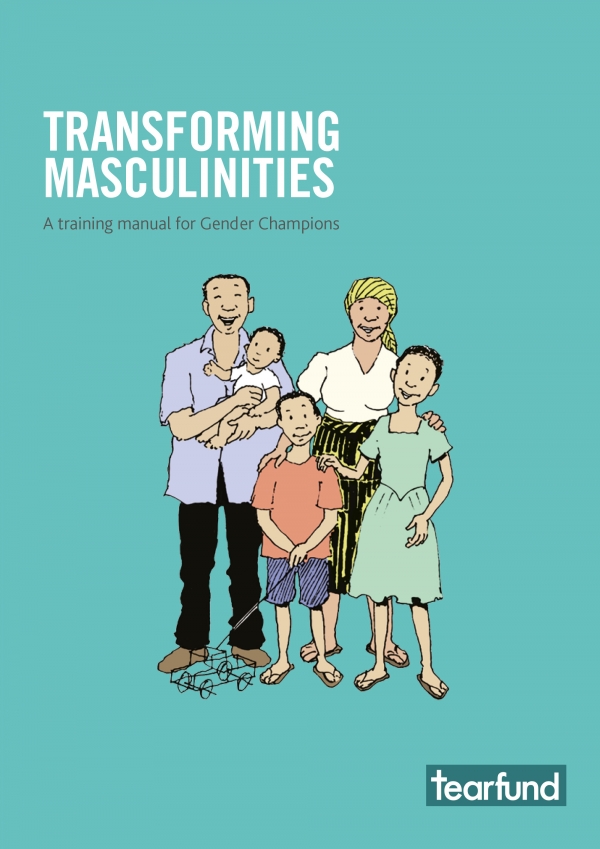
Promoting respectful relationships and equitable communities
The community dialogues are a tool that Gender Champions can use to facilitate a series of reflections and dialogues. Their ultimate aim is for individuals to be transformed. This tool will be most effective if used in the context of the Transforming Masculinities approach. The discussion themes are tailored for both women’s and men’s groups, with the expectation they will come together for a joint reflection in Week 6. The themes are intended to prompt personal reflection and deepen understanding of the topics; the Gender Champions’ (facilitators’) knowledge will also feed into this process.
Additional Info
- Country Democratic Republic of Congo
- Project Tearfund - DRC
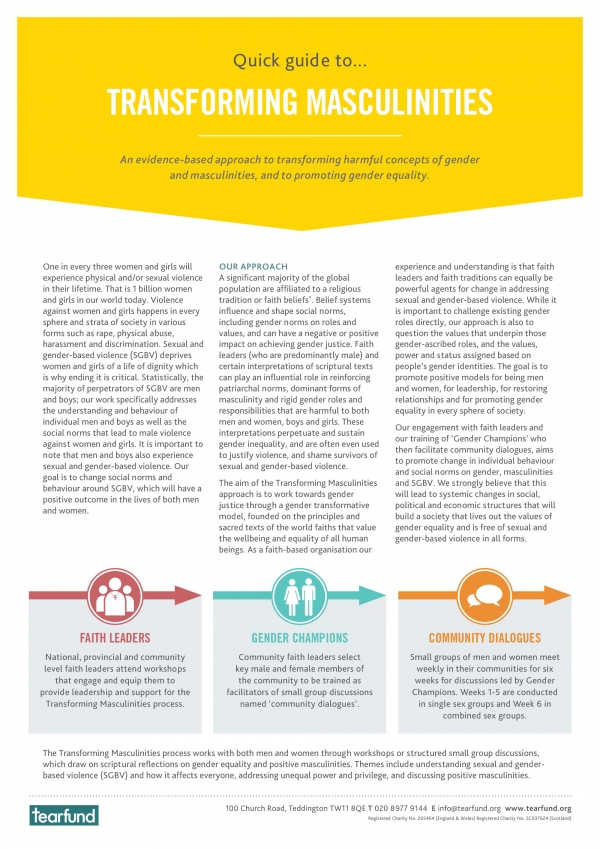
‘Gender Champions’ are men and women who volunteer within communities to lead and facilitate change with respect to gender norms, gender equality and the role of faith. The aim is to support individual behaviour change, and to change social norms around gender, masculinities and sexual and gender-based violence.
Additional Info
- Country Democratic Republic of Congo
- Project Tearfund - DRC
One in every three women and girls will experience physical and/or sexual violence in their lifetime. That is 1 billion women and girls in our world today. Violence against women and girls happens in every sphere and strata of society in various forms such as rape, physical abuse, harassment and discrimination. Sexual and gender-based violence (SGBV) deprives women and girls of a life of dignity which is why ending it is critical.

Additional Info
- Country Nepal
- Project VSO International - Nepal
Sammanit Jeevan for Teens is designed to develop teenagers’ communication skills, to support their understanding of gender norms and to improve their relationships with parents, friends and other relatives. The workshop series consists of eight sessions which will help teenagers to understand the gender norms that exist in their community and family and improve their communications skills. It will provide them with information about their sexual and reproductive health and help them develop their future goals and ways to achieve these, including improving future career prospects. (Also available in Nepali)

Additional Info
- Country Nepal
- Project VSO International - Nepal
Sammanit Jeevan – EE & IGA Support Manual for Economic Empowerment and Income Generating Activity Support is a workshop series designed to promote families’ understanding of financial management of household budgets and strengthen household economies. Sammanit Jeevan – EE & IGA Support is a complementary manual to the Sammanit Jeevan – EE & IGA Support intervention designed to promote gender equity and harmonious partner and families’ relationships and reduce violence against women and girls in Nepal. (Also available in Nepali)

Additional Info
- Country Nepal
- Project VSO International - Nepal
Sammanit Jeevan is a workshop series designed as a tool to help promote harmony within families and reduce violence. The workshop’s series of 10 sessions address questions of gender, relationships, family conflict, violence, communication, and relationship skills. When families have members that are unhappy or are abused, there is impact on other family members. When children are exposed to unhappy relationships or violence it can affect their relationships later in life. When there is conflict within a family it affects everyone. (Also available in Nepali)

Additional Info
- Country Tajikistan
- Project International Alert - Tajikistan
- Author -
- Date of publication -
Part 1: Social empowerment
Zindagii Shoista is a workshop series designed to help promote harmony within families and reduce violence. By considering wider family dynamics when working with local communities, it aims to create a socio-economic environment that enables women to enjoy greater protection from sexual and gender-based violence, with a focus on violence against women and girls.
Additional Info
- VAWG themes VAWG & Social Norms
- Country Nepal
- Project VSO International - Nepal
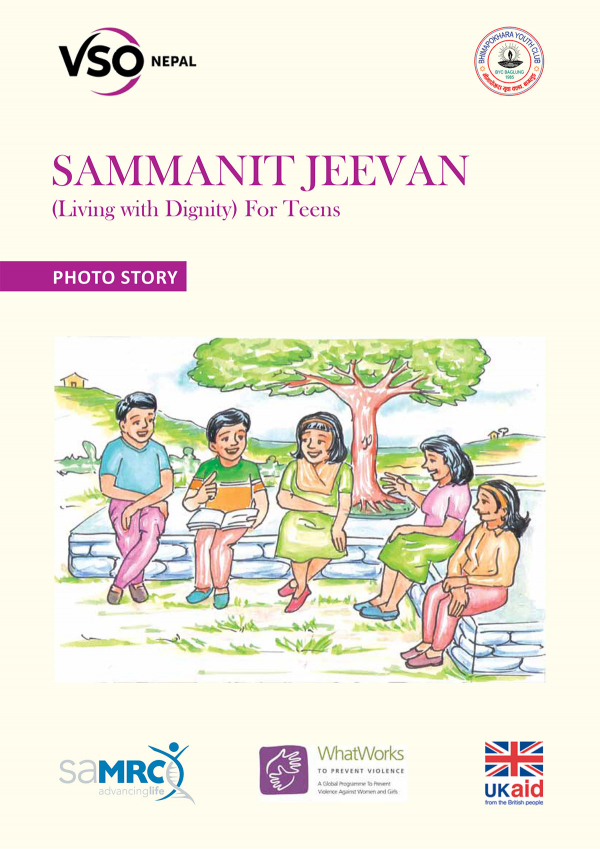
This photo story is part of the Interventional Manual SAMMANIT JEEVAN (Living with Dignity) FOR TEENS, and is one of the sessions for raising awareness on prevention of child marriage.

Additional Info
- Country Tajikistan
- Project International Alert - Tajikistan
Part 2: Enabling economic empowerment through income generating activities
Zindagii Shoista: Enabling economic empowerment (EE) through income generating activities (IGAs) is a workshop designed to promote families’ understanding of managing household budgets in order to strengthen household economies. Part 2 of the Zindagii Shoista manual, focusing on enabling EE through IGAs, complements the Zindagii Shoista intervention (Part 1) designed to promote gender equity and harmonious partner and family relationships, with the aim of reducing violence against women and girls in Tajikistan.
Gibbs, A., Jewkes, R., Willan, S., & Washington, L. (2018). Associations between poverty, mental health and substance use, gender power, and intimate partner violence amongst young (18-30) women and men in urban informal settlements in South Africa: A cross-sectional study and structural equation model. PLoS one, 13(10), e0204956.
Effect of Childhood Poverty and Trauma on Adult Depressive Symptoms Among Young Men in Peri-Urban South African Settlements
Hatcher, A. M., Gibbs, A., Jewkes, R., McBride, R., Peacock, D., & Christofides, N. (n.d.). Effect of Childhood Poverty and Trauma on Adult Depressive Symptoms Among Young Men in Peri-Urban South African Settlements. Journal of Adolescent Health.
Intersections of violence against women and girls with state-building and peace-building: Lessons from Nepal, Sierra Leone and South Sudan
Additional Info
- VAWG themes VAWG in Conflict and Humanitarian Crises, VAWG & Social Norms
- Country Nepal, South Sudan
This study draws on three case countries – Nepal, Sierra Leone and South Sudan – to address gaps in evidence and understanding on violence against women and girls (VAWG) during post-conflict transition. It highlights the potential for state-building and peacebuilding processes to address VAWG, and the effect this has in advancing sustainable peace.
This is the first time that a systematic approach has been taken to bridge the gap between VAWG and post-conflict state-building / peace-building policies and processes. The study was led by the George Washington Institute (GWI), CARE International UK and International Rescue Committee (IRC).
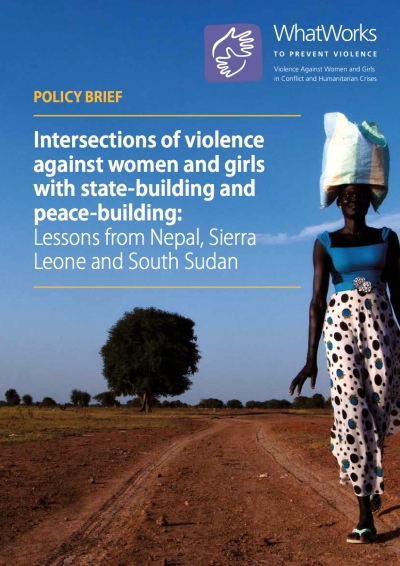
Intersections of violence against women and girls with state-building and peace-building: Lessons from Nepal, Sierra Leone and South Sudan - Policy Brief
Additional Info
- VAWG themes VAWG in Conflict and Humanitarian Crises
- Country Nepal, South Sudan
- Project Indashyikirwa - Rwanda
This study draws on three case countries – Nepal, Sierra Leone and South Sudan – to address gaps in evidence and understanding on violence against women and girls (VAWG) during post-conflict transition. It highlights the potential for state-building and peacebuilding processes to address VAWG, and the effect this has in advancing sustainable peace.
This is the first time that a systematic approach has been taken to bridge the gap between VAWG and post-conflict state-building / peace-building policies and processes. The study was led by the George Washington Institute (GWI), CARE International UK and International Rescue Committee (IRC).
This policy brief summarises findings from the study for policy makers.
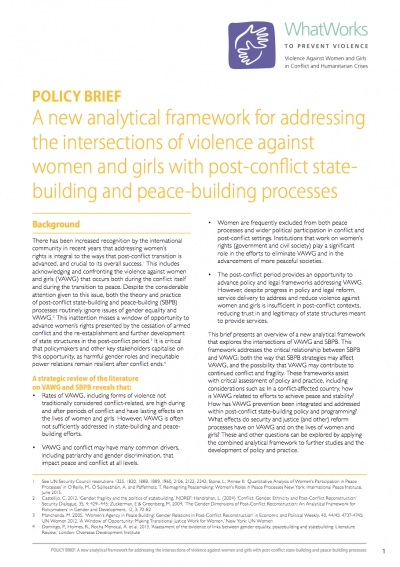
A new analytical framework for addressing the intersections of violence against women and girls with post-conflict statebuilding and peace-building processes
Additional Info
- VAWG themes VAWG in Conflict and Humanitarian Crises
- Country South Sudan
- Project Indashyikirwa - Rwanda
This study draws on three case countries – Nepal, Sierra Leone and South Sudan – to address gaps in evidence and understanding on violence against women and girls (VAWG) during post-conflict transition. It highlights the potential for state-building and peacebuilding processes to address VAWG, and the effect this has in advancing sustainable peace.
This is the first time that a systematic approach has been taken to bridge the gap between VAWG and post-conflict state-building / peace-building policies and processes. The study was led by the George Washington Institute (GWI), CARE International UK and International Rescue Committee (IRC).
This policy brief includes an analytical framework, which is a practical tool that can be used by policy makers as a guide to designing fair, inclusive, and sustainable state-building and peace-building processes that include meaningful engagement with the issue of violence and women and girls.
Alangea, D. O., Addo-Lartey, A. A., Sikweyiya, Y., Chirwa, E. D., Coker-Appiah, D., Jewkes, R., & Adanu, R. M. K. (2018). Prevalence and risk factors of intimate partner violence among women in four districts of the central region of Ghana: Baseline findings from a cluster randomised controlled trial. PloS one, 13(7), e0200874.