Evidence HubWhat Works Resources

Facilitators’ understandings of success in a participatory HIV and IPV prevention intervention in urban South Africa
Participatory approaches to behaviour change dominate HIV- and intimate partner violence prevention interventions. Research has identified multiple challenges in the delivery of these. In this article, we focus on how facilitators conceptualize successful facilitation and how these understandings may undermine dialogue
and critical consciousness, through a case study of facilitators engaged in the delivery of Stepping Stones and Creating Futures and ten focus-group discussions held with facilitators.
Additional Info
- VAWG themes VAWG in Conflict and Humanitarian Crises
- Country Philippines
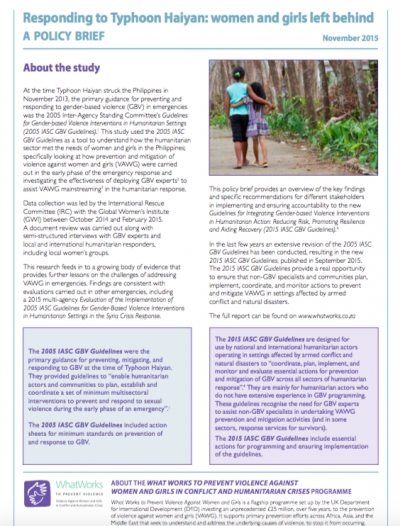
At the time Typhoon Haiyan struck the Philippines in November 2013, the primary guidance for preventing and responding to gender-based violence (GBV) in emergencies was the 2005 Inter-Agency Standing Committee's Guidelines for Gender-based Violence Interventions in Humanitarian Settings. This study used the 2005 IASC GBV Guidelines as a tool to understand how the humanitarian sector met the needs of women and girls in the Phlippines; specifically looking at how prevention and mitigation of violence against women and girls (VAWG) were carried our in the early phase of the emergency response and investigating the effectiveness of deploying GBV experts to assist VAWG mainstreaming in the humanitarian response.

Additional Info
- VAWG themes VAWG & Social Norms
- Country South Africa
- Project Sonke Gender Justice - South Africa
Most evidence on violence against women comes from speaking with women. It is crucial to understand how men themselves report using violence against women, and to identify ways to intervene in this human rights challenge. There is an urgent need to engage men in challenging rigid ideas about manhood and encourage men to become agents of change in their own communities. Researchers studied feedback from men from a peri-urban community on the outskirts of Johannesburg, where many people live in informal settlements. Men taking part were between 18 to 40 years old, with the average participant aged 27. This brief outlines the findings.

This study uses the 2005 Guidelines for Gender-based Violence Interventions in Humanitarian Settings as a tool to assess how the humanitarian sector met the needs of women and girls in the response to Typhoon Haiyan in the Philippines. It specifically looks at how prevention and mitigation of violence against women and girls (VAWG) were carried out in the early phase of the emergency response and investigates the effectiveness of deploying gender-based violence experts to assist with mainstreaming VAWG prevention and response activities across the humanitarian response. It also links to the revised Guidelines for Integrating Gender-based Violence Interventions in Humanitarian Action, published in September 2015, with recommendations for implementation, funding, research, and more.
Conceptualising Violence – A Holistic Approach to Understanding Violence Against Women and Girls
Additional Info
- VAWG themes VAWG & Social Norms
- Author S Scriver, N Duvvury, S Ashe, S Raghavendra, and D. O’Donovan
- Date of publication November 2015
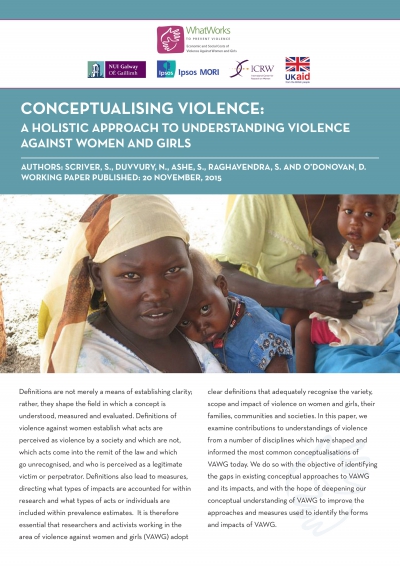
Definitions are not merely a means of establishing clarity; rather, they shape the field in which a concept is understood, measured and evaluated. Definitions of violence against women establish what acts are perceived as violence by a society and which are not, which acts come into the remit of the law and which go unrecognized, and who is perceived as a legitimate victim or perpetrator. It is therefore essential that researchers and activists working in the area of violence against women and girls (VAWG) adopt clear definitions that adequately recognize the variety, scope and impact of violence on women and girls, their families, communities and societies.
This paper examines contributions to understandings of violence from a number of disciplines which have shaped and informed the most common conceptualisations of VAWG today. Though a review of existing literature demonstrates a growing understanding of the complexity and interconnection between types of violence, contexts and consequences, nevertheless this paper suggests gaps remain in terms of our conceptualisation and understanding of the impact of VAWG, including the cumulative social and economic costs of multiple experiences of violence across the individual life-time.
Global Evidence Reviews: Paper 4: Approaches to scale-up and assessing cost-effectiveness of programmes to prevent violence against women and girls
Additional Info
- VAWG themes VAWG & Social Norms
- Author Michelle Remme, Christine Michaels-Igbokwe and Charlotte Watts
- Date of publication September 2015
This is the fourth in a series of four evidence review papers produced by What Works to Prevent Violence Against Women and Girls, a £25 million global programme funded by the UK Department for International Development which seeks to understand and address the underlying causes of violence across Africa, Asia and the Middle East. This paper reviews the evidence found on the cost and value for money of interventions to prevent VAWG, as well as on approaches for scaling up such interventions.

Global Evidence Reviews: Paper 3: Response mechanisms to prevent violence against women and girls
Additional Info
- VAWG themes VAWG & Social Norms
- Author Rachel Jewkes, Lindsay McLean Hilker, Seema Khan, Emma Fulu, Federica Busiello and Erika Fraser
- Date of publication September 2015
This is the third in a series of four evidence review papers produced by What Works to Prevent Violence Against Women and Girls, a £25 million global programme funded by the UK Department for International Development which seeks to understand address the underlying causes of violence across Africa, Asia and the Middle East. VAWG responses mechanisms have, for the most part, been developed and deployed with the primary goal of providing improved support services to women and girl survivors, through strengthening the response of the police and criminal justice system, and the health and social sector. An assumption is often made that strengthened response mechanisms will also lead to a decrease in rates of violence. For example, a victim of intimate partner violence may be less likely to return to an abusive relationship following their interaction with and support from the health and social sectors. This paper examines the evidence base on the effectiveness of response mechanisms in preventing the re occurrence of VAWG, a key question in the field of violence prevention and concludes that widely held assumptions have not yet been proven, and indeed further research is needed.
Global Evidence Reviews: Paper 2: Interventions to prevent violence against women and girls
Additional Info
- VAWG themes VAWG & Social Norms
- Author Emma Fulu and Alice Kerr-Wilson
- Date of publication September 2015
This is the second in a series of four evidence review papers produced by What Works to Prevent Violence Against Women and Girls, a £25 million global programme funded by the UK Department for International Development which seeks to understand address the underlying causes of violence across Africa, Asia and the Middle East. This evidence review identifies some of the most effective interventions which promise to reduce VAWG through targeting the key risk factors for violence perpetration and experiences.

Global Evidence Reviews: Paper 1: State of the field of research on violence against women and girls
Additional Info
- VAWG themes VAWG & Social Norms
- Author Emma Fulu and Lori Heise
- Date of publication September 2015
This is the first in a series of four evidence review papers produced by What Works to Prevent Violence Against Women and Girls, a £25 million global programme funded by the UK Department for International Development which seeks to understand address the underlying causes of violence across Africa, Asia and the Middle East. This paper outlines the current knowledge base regarding the issue of VAWG and identifies where the evidence base needs to be expanded in order to inform more sophisticated interventions and make a real impact on the prevalence of VAWG globally, in the hope that this information will be used to drive current policies and programme as well as future endeavours.

Additional Info
- VAWG themes VAWG & Social Norms
This report presents the findings of a global survey of 309 violence against women and girls (VAWG) stakeholders, including practitioners, policymakers, researchers and activists. The anonymous online survey was completed between August-September 2014, with the link sent out through various VAWG networks, listservs and Twitter contacts. The survey aims to help the What Works to Prevent Violence programme learn how best to communicate findings to key stakeholders, by generating information on knowledge and understanding of primary prevention and perceived barriers to evidence-based prevention. These findings will be used to directly inform and advance the What Works to Prevent Violence communications and research uptake strategies.
Factors associated with IPV victimization and perpetration by men in migrant communities of Nepal
Shai, N.; Pradhan G.D.; Chirwa, E.; Shrestha, R.; Adhikari, A.; Kerr, A. Factors associated with IPV victimization and perpetration by men in migrant communities of Nepal