Evidence HubWhat Works Resources
- You are here:
-
Evidence Hub

- What Works

What Works
What Works - Top Tips for Planning and Writing Briefs
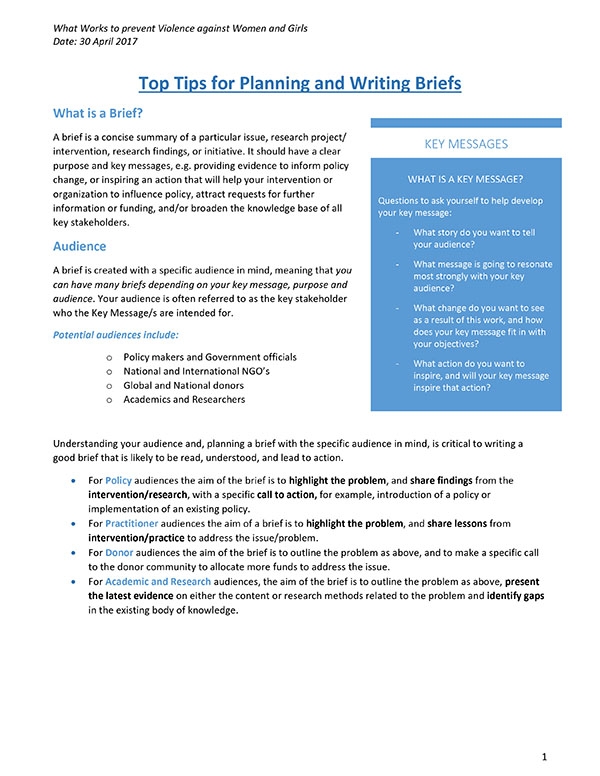
A brief is a concise summary of a particular issue, research project/ intervention, research findings, or initiative. It should have a clear purpose and key messages, e.g. providing evidence to inform policy change, or inspiring an action that will help your intervention or organization to influence policy, attract requests for further information or funding, and/or broaden the knowledge base of all key stakeholders.
Introduction to VAW Training Manual

When the Gender Centre conceptualized its Nkyinkyim Anti-violence Project/Rural Response System, it recognized the need to put together a comprehensive training programme for its partners to ensure a full understanding of violence against women in order to be able to respond effectively to victims of violence in those communities where its partners operated. The training programme was also intended to train other civil society organisations as well as state agencies such as the Police, health and social welfare personnel and indeed all stakeholders who interacted with victims of violence in any way. The manual has been the main resource for training of our COMBAT members.
If you would like to get access to the full curricula please email Dorcas Coker-Appiah at d.cokerappiah@gendercentreghana.org

In Ghana, violence against women and girls is widespread. Recent estimates indicate that 28% of women report at least one form of violence in the past year and 45% report experiencing violence at some point in their lifetime. COMBAT (Community Based Action Teams) is a rural response strategy that aims to (i) reduce the incidence of VAWG in rural communities in Ghana, (ii) protect women’s rights via state and community structures; and, (iii) raise public awareness about the causes and consequences of VAWG. This evidence suggests that community-led evidence-based interventions supported by local actors (e.g. traditional and religious leaders) are uniquely placed to support prevention of, and response to, VAWG in this context.
A Facilitators’ Guide for Training Female Sex Workers

The response to the HIV epidemic through targeted interventions focused largely on changing individual behaviour and encouraged female sex workers to use condoms correctly, continuously and consistently with their clients. However, subsequent studies reported that although condom usage during sexual interactions with clients increased, their usage was less consistent with intimate partners (also known as lovers and as Hiriya or Malak in the context of Karnataka) of female sex workers. It was also observed that where condom use has been inconsistent, experience of violence has been high.
BIG Change Curriculum

Intimate partner violence (IPV) is a significant public health issue that affects 1 in 3 women globally. Despite these numbers, little is known about what can be done in communities to prevent it.
Change Starts at Home was created to address this. Focused on an innovative radio program and weekly (listening and discussion) group meetings, the Change Starts at Home approach uses media and peer to peer support to address social norms, attitudes, and behaviors that perpetuate and support intimate partner violence.
The BIG (B: Begin to Question, I: Impart Life Skills and G: Go!) Change curriculum was developed for the facilitators of the Listening and Discussion Groups (LDGs), and is designed to support them to facilitate weekly sessions with group members. By following each week of the curriculum, facilitators will be able to guide group members through a planned approach of listening, discussion, activities, reflection and home-based tasks on weekly basis.
The curriculum is divided in three different phases, B: Begin to Question, the Critical Reflection Phase, I: Impart Life Skills; the Skill Building Phase, and G: Go! The Action and Community Diffusion Phase.
Holistic Child Development - Games Manual

This section of the Manual contains 100 games. These games promote learning and growth for every child who participates. The games have been revised and tested in order to ensure that each game is easy to follow and contributes to the holistic development of the child.
Samvedana Plus - Implementation Design

The influence of structural factors such as poverty, social norms, alcohol abuse, and criminalisation of high-risk behaviours on HIV risk and vulnerability has led scholars and HIV prevention programmers to regard structural intervention as an essential component of an HIV prevention strategy. Structural interventions reduce risk and vulnerability among female sex workers (FSWs) by empowering them with greater control over condom use with clients, and reducing violence and stigma against them.