Evidence HubWhat Works Resources
- You are here:
-
Evidence Hub

- What Works

What Works
Dialogues Communautaires

Promouvoir des relations respectueuses et des communautés équitables
Les dialogues communautaires sont un outil que les champions de genre (défenseurs de l’égalité hommes-femmes) peuvent utiliser pour animer des sessions de réflexion et de dialogue. Leur but ultime est que les personnes qui y participent soient transformées. Cet outil sera d’autant plus efficace s’il est utilisé dans le contexte de l’approche Transformer les masculinités. Les thèmes de discussion sont respectivement adaptés au groupe de femmes et au groupe d’hommes, qui sont censés se réunir pour une réflexion commune lors de la sixième semaine.
Transformer Les Masculinités - Manuel de formation

Les « champions de genre » sont des hommes et des femmes qui se portent volontaires au sein des communautés pour inspirer et faciliter des changements relatifs aux normes de genre, à l’égalité hommes-femmes et au rôle de la foi. L’objectif est d’accompagner un changement de comportement individuel et de changer les normes sociales liées au genre, aux masculinités et aux violences sexuelles basées sur le genre.
Transformer Les Masculinités - Guide Rapide

Une femme et une fille sur trois subiront des violences physiques ou sexuelles au cours de leur vie. Cela représente un milliard de femmes et de filles dans le monde aujourd’hui. Les violences à l’égard des femmes et des filles existent dans toutes les sphères et les strates de la société, sous diverses formes, comme le viol, la maltraitance physique, le harcèlement et la discrimination. La violence sexuelle et basée sur le genre (VSBG) empêche les femmes et les filles de vivre dans la dignité. C’est pourquoi il faut impérativement y mettre fin.
Community Dialogues

Promoting respectful relationships and equitable communities
The community dialogues are a tool that Gender Champions can use to facilitate a series of reflections and dialogues. Their ultimate aim is for individuals to be transformed. This tool will be most effective if used in the context of the Transforming Masculinities approach. The discussion themes are tailored for both women’s and men’s groups, with the expectation they will come together for a joint reflection in Week 6. The themes are intended to prompt personal reflection and deepen understanding of the topics; the Gender Champions’ (facilitators’) knowledge will also feed into this process.
Transforming Masculinities - Training Manual

‘Gender Champions’ are men and women who volunteer within communities to lead and facilitate change with respect to gender norms, gender equality and the role of faith. The aim is to support individual behaviour change, and to change social norms around gender, masculinities and sexual and gender-based violence.
Transforming Masculinities - Quick Guide

One in every three women and girls will experience physical and/or sexual violence in their lifetime. That is 1 billion women and girls in our world today. Violence against women and girls happens in every sphere and strata of society in various forms such as rape, physical abuse, harassment and discrimination. Sexual and gender-based violence (SGBV) deprives women and girls of a life of dignity which is why ending it is critical.
VAWG Prevention Curricula
 Since 2015 the What Works to Prevent Violence Against Women and Girls Programme has developed, adapted, and implemented 15 evidence-based VAWG prevention interventions across the Global Programme projects in Africa and Asia.
A significant part of the What Works mandate was to ensure these 15 interventions were evidence-based and implemented effectively. To this end DFID and What Works invested resources to support the development and/or adaptation of many of the interventions. All were implemented alongside rigorous evaluation research to test effectiveness.
To support effective implementation, the What Works programme assisted projects to ensure facilitators were well trained with ongoing support and able to deliver the intervention as intended. We also supported in-depth process monitoring of intervention delivery to deepen our understanding of challenges and successes. All the interventions have been rigorously evaluated, and results are available, and/or will be shortly – please peruse the website for information on this.
We are committed to the wide use of these resources as a contribution to preventing VAWG globally. To achieve this we have shared the interventions, either directly here, or by providing a link to where the curriculum/manual is hosted. We encourage everyone to review these manuals and if appropriate to your setting and context, to adapt and implement them, with the necessary acknowledgments.
Curricula
International Alert - Tajikistan
International Alert - Tajikistan
-
Zindagii Shoista – Living With Dignity: Workshop Manual Part 1

Part 1: Social empowerment
Zindagii Shoista is a workshop series designed to help promote harmony within families and reduce violence. By considering wider family dynamics when working with local communities, it aims to create a socio-economic environment that enables women to enjoy greater protection from sexual and gender-based violence, with a focus on violence against women and girls. -
Zindagii Shoista – Living With Dignity: Workshop Manual Part 2

Part 2: Enabling economic empowerment through income generating activities
Zindagii Shoista: Enabling economic empowerment (EE) through income generating activities (IGAs) is a workshop designed to promote families’ understanding of managing household budgets in order to strengthen household economies. Part 2 of the Zindagii Shoista manual, focusing on enabling EE through IGAs, complements the Zindagii Shoista intervention (Part 1) designed to promote gender equity and harmonious partner and family relationships, with the aim of reducing violence against women and girls in Tajikistan.












Teen Manual

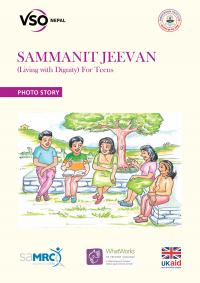
Sammanit Jeevan for Teens is designed to develop teenagers’ communication skills, to support their understanding of gender norms and to improve their relationships with parents, friends and other relatives. The workshop series consists of eight sessions which will help teenagers to understand the gender norms that exist in their community and family and improve their communications skills. It will provide them with information about their sexual and reproductive health and help them develop their future goals and ways to achieve these, including improving future career prospects. (Also available in Nepali)

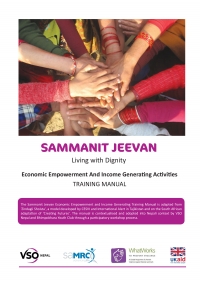
Sammanit Jeevan – EE & IGA Support Manual for Economic Empowerment and Income Generating Activity Support is a workshop series designed to promote families’ understanding of financial management of household budgets and strengthen household economies. Sammanit Jeevan – EE & IGA Support is a complementary manual to the Sammanit Jeevan – EE & IGA Support intervention designed to promote gender equity and harmonious partner and families’ relationships and reduce violence against women and girls in Nepal. (Also available in Nepali)
Gender Transformative Norms - Training Manual

Sammanit Jeevan is a workshop series designed as a tool to help promote harmony within families and reduce violence. The workshop’s series of 10 sessions address questions of gender, relationships, family conflict, violence, communication, and relationship skills. When families have members that are unhappy or are abused, there is impact on other family members. When children are exposed to unhappy relationships or violence it can affect their relationships later in life. When there is conflict within a family it affects everyone. (Also available in Nepali)