Evidence HubWhat Works Resources
- You are here:
-
Evidence Hub

- What Works

What Works
Teaching boys that 'real men' would stop rape

Isaac, a 15-year-old boy, watched as a group of men grabbed a young girl. It was a bustling new year's eve in Kibera, Kenya's largest slum, and he knew she was in trouble.
He also knew he didn't have the strength to fight off those older, larger men. Having been taught to intervene if he sees predatory behaviour, Isaac called over another man to help confront the group.
A Worldwide Teaching Program to Stop Rape

Second in a three-part series about solutions for sexual assault.
High rates of sexual assaults on college campuses get a lot of attention — and rightly so. But do you know what group has higher rates of sexual assault and rape than college women? College-age women who aren’t in college.
Student Corner: Developing Effective Methods of Preventing Sexual Assault in Rural Kenya
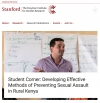
Gender-based sexual violence is pandemic—preventing it seems almost impossible. But Clayman Institute Faculty Research Fellow Mike Baiocchi’s new research proves intervention and prevention are possible.
In his Faculty Research Fellows (FRF) presentation, “Establishing an Empirical Foundation for Preventing Gender-Based Violence,” Baiocchi delivered a comprehensive overview of the crucial, multi-year research that he and his team—Clea Sarnquist, a senior research scholar at the Stanford Global Child Health Program in the Department of Pediatrics, and his colleagues at the Stanford Gender-Based Violence Prevention Collaborative—have conducted in an effort to uncover the root causes of sexual violence in order to create interventions to end the pandemic. Earlier findings from this research were presented by Baiocchi and Sarnquist at the Clayman Institute’s 2017 winter symposium on “Breaking the Culture of Sexual Assault.”
GROW! Dialogue: lndashyikirwa "Agents of Change"

On April 11th, Dr. Kristin Dunkle presented her work on developing and testing a multi-level intervention to prevent intimate partner violence in Rwandan communities. Dr. Dunkle is Chief Specialist Scientist in the What Works to Prevent Violence Against Women and Girls Programme at the South African Medical Research Council. She has been working on gender-based violence and sexual violence in Africa since 1994. We had a chance to interview her about her work. Watch the interview
On April 26, our final seminar of the 2017-2018 academic year featured Dr. Nadine Kaslow on the Nia Project, which assists abused and suicidal African American women.
No safe place: A lifetime of violence for conflict-affected women and girls in South Sudan - Summary Report 2017

 |
|
|
Main Results Report 2017 |
Violence against women and girls (VAWG) is a serious human rights violation and a significant global health and security issue. Studies suggest that the rates, perpetrators and types of VAWG fluctuate during conflict; and there is some evidence that sexual violence against both women and men increases during conflict. The global prevalence of sexual violence among refugees and displaced persons in humanitarian crises is estimated to be 21.4%, suggesting that approximately one in five women who are refugees or displaced by an emergency experience sexual violence. Recent studies indicate that intimate partner violence (IPV) may be more common than conflict-related sexual assault; however, both IPV and conflict-related violence are under-reported in these settings. Though several studies have collected robust data on VAWG in humanitarian settings, many experts argue that our overall understanding of the issue remains limited.
Kate Bishop

Kate Bishop
Social Development Direct
Kate Bishop is a Senior Technical specialist and Lead Consultant for Social Development Direct’s Gender Based Violence (GBV) portfolio. She has 14 years’ experience working on Violence against Women and Girls, women’s rights, and gender equality across a range of development contexts.
Dr. Giulia Ferrari

Dr. Giulia Ferrari
London School of Economics and Political Science
Giulia Ferrari originally trained as a quantitative economist at Bocconi University (Milan, Italy), and obtained a PhD in International Development at the London School of Economics and Political Science.
Dr. Kristin Dunkle

Dr. Kristin Dunkle
South African Medical Research Council
Dr. Kristin L. Dunkle is a Chief Specialist Scientist in the Gender and Health Research Unit at the SAMRC. Dr. Dunkle is a social epidemiologist who has been working on gender-based violence and health for over 20 years, and has published widely on: connections between intimate partner violence and HIV among both women and men; links between gender‐based violence, transactional sex, and poverty; intimate partner violence; sexual violence and health among men who have sex with men (MSM) and others in LGBTQIA communities.
Changing Lives Through Financial Independence: Economic empowerment is key in enabling women to speak up against violence.


Indashyikirwa, meaning ‘agents for change’, is a program that seeks to prevent intimate partner violence (IPV) across Rwanda, and is being implemented by CARE Rwanda, Rwanda Women’s Network (RWN) and Rwanda Men’s Resource Center (RWAMREC). One component of the program was a 5-month weekly curriculum with 840 heterosexual couples recruited from CARE’s micro-finance village savings and loans associations. The participatory curriculum supported couples to examine power in their own lives, identify and manage triggers of IPV, and build skills for healthy, equal relationships. Using the VSLAs as a platform responded to CARE Rwanda’s (2012) assessment of this programming, which found that in many cases, men were controlling the function of the microfinance groups and money, and many women did not feel confident to make decisions about a loan without their husband’s approval. Approximately 25% of couples that completed the Indashyikirwa curriculum were supported to facilitate activism in their communities around the benefits of non-violent relationships for an additional two years. Read the full article here