Evidence HubWhat Works Resources
- You are here:
-
Evidence Hub

- What Works

What Works
David stops hitting

Karnataka Health Promotion Trust, Samvedana Plus project, India
David* is a 25 year old man, who works as driver and is married. He has had an ongoing intimate relationship with a FSW for more than seven years. They have had a difficult relationship for many years, which has often led to him physically abusing her.
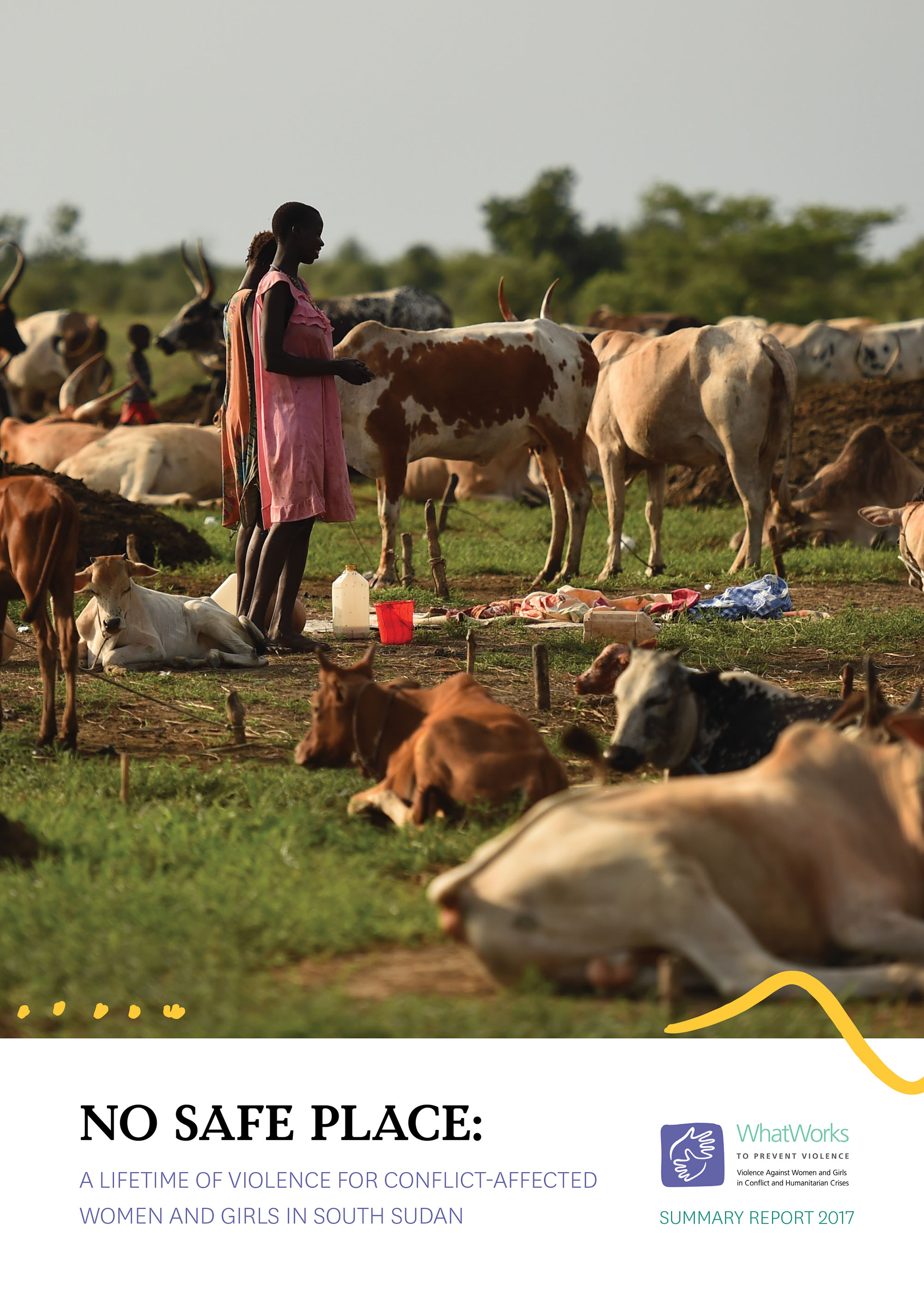
No safe place: A lifetime of violence for conflict-affected women and girls in South Sudan - Main Results Report 2017

 |
|
|
Summary Report 2017 |
Violence against women and girls (VAWG) is a serious human rights violation and a significant global health and security issue. Despite the progress made in addressing VAWG since the landmark Fourth World Conference on Women, VAWG remains a pandemic issue. In 2013, the World Health Organization (WHO) estimated that 35% of women globally experience sexual and/or physical intimate partner violence (IPV) or sexual assaulta at some point in their lives. There is some evidence that indicates that sexual violence against both women and men increase during conflict. The global prevalence of sexual violence among refugees and displaced persons in complex humanitarian emergencies is estimated to be 21.4%, suggesting that approximately one in five women who are refugees or displaced by an emergency experience sexual violence. Recent studies indicate that IPV may actually be more common than conflictrelated sexual assault. However, these figures should be interpreted with caution, as both IPV and conflict-related violence are under-reported in most settings.
South Sudan war seeps into homes, spurring domestic violence
NEW YORK, Nov 29 (Thomson Reuters Foundation) - Civil war in South Sudan is generating unseen levels of domestic violence, according to a study released today showing a reported increase in the brutality and frequency of assaults.
Tens of thousands of people have been killed and a third of the East African country’s 12 million residents have been forced to flee since civil war broke out in 2013.
More than half of the South Sudanese women interviewed said they have suffered domestic abuse in their lives, according to the study by George Washington University (GW) and the International Rescue Committee.
Find out on Wed 6 Dec 2017 at London School of Hygiene & Tropical Medicine, 10am GMT
The What Works to prevent Violence against women and girls global programme (What Works), funded by UKAID has been conducting rigorous research for the last three years on primary prevention and complementary responses to ensure that fewer women and girls in the global South experience gender-based violence.
This event will present an overview of the What Works programme and progress to date; present the most important currently recognized drivers of violence against women and girls and the latest evidence on the prevalence, forms and patterns and drivers of VAWG in conflict and humanitarian settings, based on research conducted in South Sudan. In addition, What Works in-country partners will present interventions in action from research conducted in the Democratic Republic of Congo, Tajikistan, and Nepal.
When: Wednesday 6 December 2017, 10am – 2pm
Where: John Snow Lecture Theatre, LSHTM, Keppel Street, London, WC1E 7HT, UK
Admission: Free to attend but registration is required. Please register here: https://whatworks_vawg.eventbrite.co.uk
For those unable to attend: The event will be live streamed here: https://panopto.lshtm.ac.uk/Panopto/Pages/Viewer.aspx?id=86410ca8-88ea-4ab0-8afa-71cb12788513
Follow the conversations on social media using #WhatWorksLSHTM
Gowri starts to use condoms

Karnataka Health Promotion Trust, Samvedana Plus project, India
Gowri* is a 35-year-old sex worker with a daily clientele. She has two regular intimate partners, with whom she reports being very compatible. As a result, she does not experience violence in intimate relationships. Given the intimacy and trust she enjoys with them, she does not use condoms in their intimate relationships.
Stacey Striver from NUI Galway for opinion in RTE on taking action against gender violence home and away
Stacey writes; the 16 Days of Activism Against Gender-Based Violence campaign began at Rutgers University in 1991 as an annual international campaign to communicate the message that gender-based violence is a violation of fundamental human rights. This campaign brings together activists, government leaders, students, academia and the private sector across the world to demand an end to gender-based violence.
The 2017 theme is "‘Together We Can End GBV in Education" and it aims to build awareness and advocate for an end to all forms of gender-based violence in education. Gender-based violence is any form of physical, sexual or psychological violence directed towards an individual on the basis of stereotypes, norms or roles associated with sexual or gendered identity. Read the full article here
BSR Bangladesh in The Dhaka Tribune

Marat Yu, Manager, BSR, who leads BSR’s HERproject programmes in Bangladesh, Myanmar, and Pakistan as well as overseeing HERrespect, the gender-based violence pillar of HERproject, is published in The Dhaka Tribune as part of the 16 Days of Activism. Marat’s article focuses on intimate partner violence in the workplace. Marat writes; "the recent surfacing of numerous sexual harassment allegations — including multiple allegations of sexual harassment in the workplace — have demonstrated how much work remains to be done to create genuinely inclusive workplaces around the world. Businesses can no longer be in any doubt about its duty to stamp out violence and harassment at work". Read the full article here
Alisher’s Story

Zindagii Shoista: Living with Dignity, Tajikistan
*Alisher is a 50-year-old married man from Tajikistan. He has five children, two sons and three daughters.
Ending Intimate Partner Violence One Couple at a Time

Change Starts at Home, Nepal
“In the past my husband used to abuse me. He didn’t count me or our daughters as human beings… he used to force me into having sex.” That is how Bikani, a Nepali woman, with two daughters, initially summarized her ten-year marriage. The experience of Ashram and Bikani is not uncommon in Nepal. A recent study carried out by Equal Access International (hyperlink) and Emory University found that 34% of survey respondents had experienced intimate partner violence in their lifetime and 25% had experienced physical or sexual abuse from their spouse in the past 12 months.
How Momin* was helped to change his ways

HERrespect, Bangladesh
Engaging male supervisors to tackle violence at work in the ready-made garment sector of Bangladesh